
Miguel and Jorge are not just friends. Both artists represent two sides of a coin forged in Chile under Pinochet: the counterculture and the mainstream—both facets of pop music driven by ideas that challenge a rigid society obsessed with success. Although they started out with sharp-edged guitars, they have shared an interest in the sounds of the machines from the very beginning—an interest they have explored both together and apart. This year, the album “Cobijo” marks a collaborative chapter in the history of two figures who, despite being wary of popular culture, have no desire to remain confined to niche scenes or the avant-garde.
“I come from La Unión, where it rains almost all the time. Much of my childhood was spent indoors; without television or mobile phones, I’d spend hours next to my parents’ Philips stereo system, listening to their vinyl records. I remember being hypnotized not just by the songs, but by the sight of a piece of plastic spinning and generating sounds that poured from the speakers; that transported me to other realities, and the sound itself was magic”.
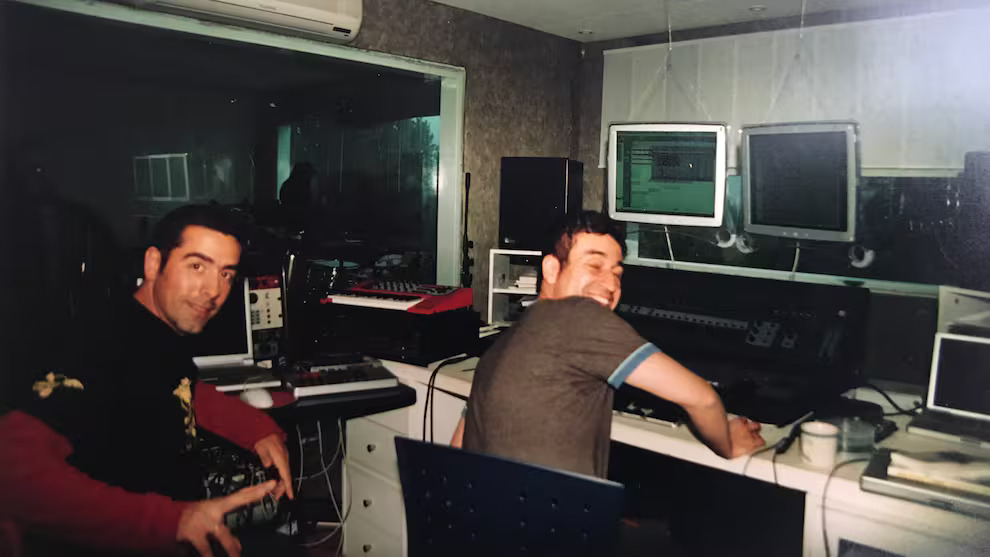
That is how Chilean musician, DJ, and producer Miguel Conejeros recalls his first encounter with the world he now explores from his recording studio in Santiago de Chile. Although he was part of the country’s first post-punk band, the sounds he explores today seem to have more in common with Aphex Twin and Orbital than with The Cure or Joy Division. Yet appearances can be deceiving, and the artist rejects easy categorizations.
“I hope it’s hard to file what we do under the ‘electronic music’ section”, Miguel said in a recent interview regarding “Cobijo” (Grieta Label, 2026), the album he recorded with his friend and comrade Jorge González. “It’s made with electronic instruments, sure, but it’s hard to classify it as house, techno, or experimental. Where do you put it? I like that, because I’ve never liked labels. I feel they shape too much the way people listen to your work”.
“Cobijo is a conversation between us through music”, he said in the same talk about a collection of songs created under the monikers F600 (Miguel) and Leonino (Jorge). “Music has always been the place we’ve turned to and where we’ve felt safe. It’s like building a house—a refuge from bad vibes and everything we go through. More than just an album, it’s a place”, he explained about a vinyl LP mixed and mastered by the German producer Uwe Schmidt (also known as Atom™, Atom Heart and Señor Coconut).
To appreciate Miguel’s creative evolution, one must first understand part of the fractured history of the country he inhabits. Although punk officially marks its fiftieth anniversary in 2026, it took several more years for the genre to take hold in Chile. In 1976, the secret police of the junta that ruled the country for 17 years were still targeting political and artistic dissent—three years into a dictatorship ushered in by the murder of singer Víctor Jara at the Estadio Chile, an event that triggered a “cultural blackout” in which the regime only tolerated art that extolled patriotism.
Consequently, punk, post-punk, and new wave arrived almost surreptitiously—tucked into the suitcases of the children of those that went into exile or in the luggage of a medical student who had traveled to Paris to reunite with a brother lost after the coup that toppled Salvador Allende. He returned from that trip with a stash of vinyl records featuring the “new music” of the time; tracks from these LPs were played on the first radio show to broadcast songs by Wire, The Clash, and Gang of Four over local airwaves.
“The music I listened to during my adolescence left the deepest mark on me, largely thanks to the cassette tapes that arrived by mail in La Unión, sent by my uncle, Marcos Vergara, and Felipe Raurich. Both were medical students who ran the radio show Nueva Dimensión. That’s where they shared musical gems that no one else knew about back then. My uncle was responsible for bringing punk and new wave records into a Chile gripped by censorship and the dictatorship,” Miguel wrote in the liner notes for the compilation album “Prototipo” (2025).
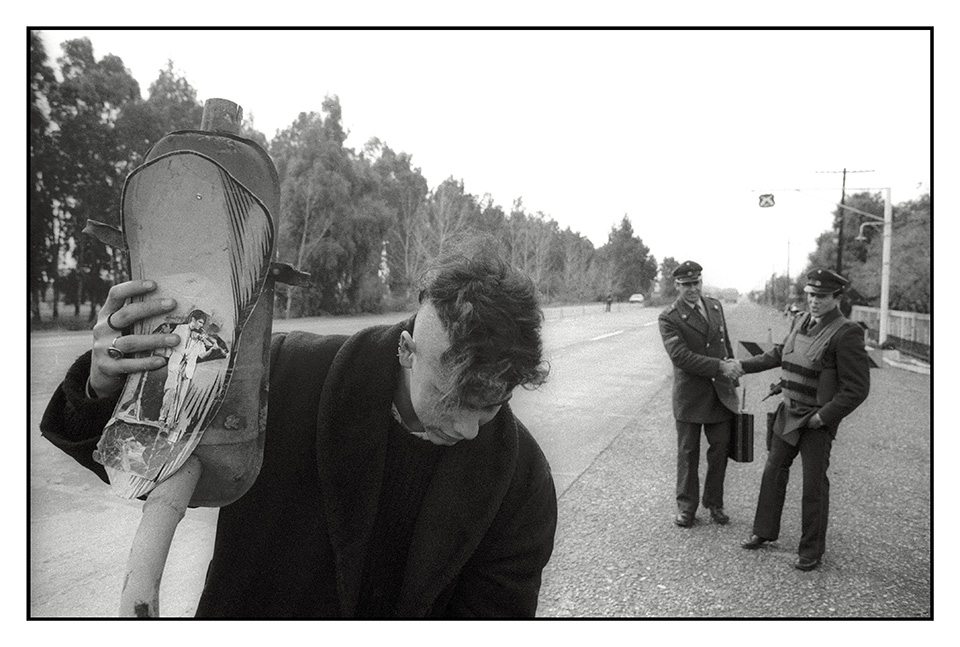
Miguel and his brother Iván later settled in Santiago and, alongside Daniel Puente Encina and Sebastián Levine, formed Chile’s first post-punk band under the provocative name Pinochet Boys. Although their live performances and the two tracks they managed to record eventually achieved legendary status, their work was initially met with open hostility—an animosity shared even by ideological rivals amidst the Cold War.
“How many times did they try to lynch us for having fuchsia hair or wearing earrings? I can’t even remember anymore, but it happened a lot; the leftists thought we were right-wingers, and the right-wingers thought we were communists. To others, we were simply faggots who had to pay the price—that’s how narrow-minded our compatriots were—whereas to us, everything was fascist, ugly, backward, and boring,” he recounted in the comments collected in “Prototipo”.
The members of Pinochet Boys connected with a new generation of artists who, while rejecting the dullness of a youth under curfew, also did not feel represented by folk protest songs frozen in time following the fall of the government of Allende. Among these skeptical voices was Jorge González—bassist and vocalist for Los Prisioneros, a group that would eventually become one of Chile’s most successful bands in terms of sales and social impact.
“Jorge and I met before the release of ‘La Voz De Los 80’ [Los Prisioneros’ debut album]. We’ve always been close; a shared passion for music has kept us connected. With Pinochet Boys, we lent him a very basic electronic drum machine—a Korg DDM-110—and he let us use his bass amp, which allowed us to plug in whenever we got together to play”. Jorge later used that drum machine to compose “El Baile de los que Sobran,” one of his band’s most iconic tracks.
A camaraderie developed between them that has spanned decades, alongside a shared desire to experiment with sounds that defy easy categorization. “We share a certain musical rapport. Communication has always been easy because we have a similar sensibility; we’ve liked more or less the same bands, the same music, and shared a similar aesthetic outlook… I like the sounds we achieve because they aren’t obvious”.
Music for the End of Times
Although the textures of the six tracks making up “Cobijo” move away from the rawness and direct criticism that characterized their output in 1984, beneath the elegance of sonic landscapes crafted with beats and samples, a heart still beats in protest against the collective amnesia that returned Pinochetism to power in Chile at the end of 2025 under the rule of ultraconservative José Antonio Kast (Jorge aptly described the recordings as “a work that could be on the Judgment Day´s playlist”).
While a shared past defines the paths they have taken, they have no interest in resting on the laurels of past glories. They are also aware of the evident paradox that arises when recalling the good days experienced during terrible times—precisely when Chilean society yearns for the order brought by the soldiers, forgetting the price paid for yielding to that temptation.
“It’s a human mechanism to remember the good things, and it’s true that back then there was a sense of community; in fact, when I speak of that time, I say ‘we’—plural—whereas when I speak of the present, I say ‘I’—singular. There was a collective pulse to our daily life, but when you look back at it all, it seems like a lot of things were happening at the same time, when in reality, the whole damn thing was boring as hell. I mean, you had to sit through Sábados Gigantes and watch fascists marching up a hill with torches to pay homage to Pinochet—let’s not forget that,” he clarifies.
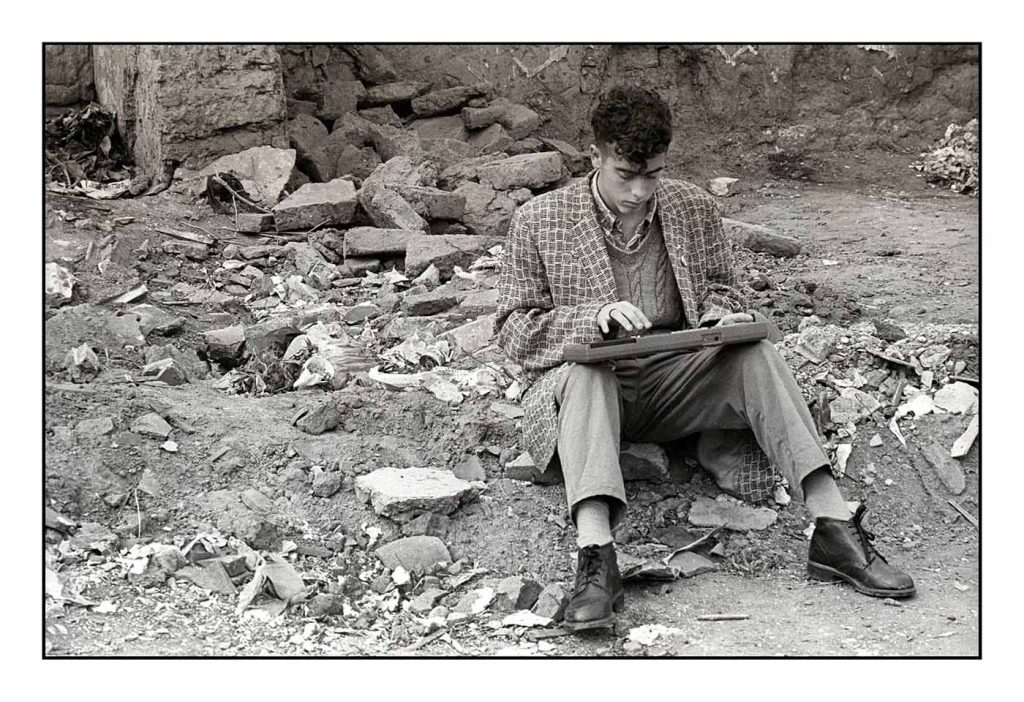
Someone who lived through those days from the perspective of those aspiring to a more compassionate society believes that the proposals offered by the new authoritarians have an impact extending beyond politics—a view inspired by theorists like Mark Fisher. “The worldview of right-wing libertarians in Chile and Kast’s Republicans is hyper-realistic. There is no room for poetry, for dreaming. Under that mindset, kids have to study engineering, because if you study literature, you’re going to fail at life”.
“This mindset—rooted in the dogma of the neoliberal system and individualism—affects both the Right and the Left parties here. What is truly terrible is that it has permeated society and fosters self-censorship among artists, who prioritize the idea of belonging or conforming to established norms. They say to themselves, ‘I won’t play that note because it’s too crazy’. People avoid taking risks for fear of being excluded,” he adds.
In the face of this utilitarianism, Miguel takes a clear stance—one shared by his partner in sonic adventures. “Jorge and I used to talk about this: what we love is the strange, the different, the odd. Stepping outside the norm is what draws us in and drives us; after all, a ‘copy-paste’ approach is just boring, isn’t it?”
This constant search for inspiration—looking forward to music recommended by his children or backward to his seminal albums—is devoid of mere revivalism. Instead, it is grounded in a spirit of nonconformity akin to Jello Biafra’s view that punk and its offshoots belong to a dissident tradition stretching back to Oscar Wilde, early jazz musicians, and the Beat poets.
“I always return to post-punk. It’s the kind of music that compels me to create. There’s also a unique narrative surrounding that scene and era. Bands back then were genuinely trying to do something different, and that’s been lost. When you make music that’s a bit ‘out there,’ you tend to get pushed out of the mainstream circuit, because there’s a standard designed for mass appeal. When I think about post-punk, it’s not out of nostalgia; it points me toward something contemporary and groundbreaking”.
Beyond trends or political ideas, both creators operate almost like artisans crafting a sound—a richness built through trial and error. They reject the allure of Artificial Intelligence (“we prefer natural stupidity,” Jorge recently remarked), viewing the process itself as a form of alchemy just as vital as the final result, according to Miguel.
“I’ve always thought that making music is like meditating. When I’m in the studio and start working, time stands still; everything becomes more abstract. It’s as if you have the ability to transform into different versions of yourself—you can be your childhood self and play for hours, your teenage self and be an idealist, or a responsible adult. A day might feel like it lasted five minutes, even though you’ve been in a loop for hours on end. It’s exhilarating to reach that ‘zero state,’ where what matters is the present—the here and now”.